Best RCM Software: 7 Top Tools for Sustainable Revenue
Most healthcare organizations mistakenly view standard medical billing software as a complete financial solution. While these tools are useful for handling your practice’s finances, high-performance revenue cycle management (RCM) software provides the deep analytics and end-to-end oversight required to manage the entire patient-to-payment lifecycle. Understanding this distinction allows your organization to eliminate systemic inefficiencies and capture maximum allowable reimbursement.
This guide explores the top platforms that provide RCM directors with the strategic visibility they need to increase efficiency and maximize their organizations’ financial health. We will break down the differences between basic billing and complete revenue management, then review the top-performing platforms currently leading the market. We’ll cover:
- What is RCM Software in Healthcare?
- How RCM Software Optimizes the Patient-to-Payment Process
- Best RCM Software Providers for 2026
- RCM Software FAQs
Is your current billing process leaking revenue?
Optimize your revenue cycle with PracticeSuite’s RCM software.

What is RCM Software in Healthcare?
Revenue cycle management (RCM) software helps medical practices manage all processes that affect their ability to generate revenue, from when a patient schedules an appointment to when they submit their final payment. It unifies clinical and financial data to ensure every service provided is documented, billed accurately, and paid in full.
Benefits of using RCM software include:
- Holistic lifecycle management: RCM software tracks every financial interaction throughout the revenue cycle, ensuring your organization captures revenue at the point of service and through the final collections phase. This spans pre-visit tasks (such as insurance verification), mid-visit tasks (such as point-of-care billing), and post-visit tasks (such as claim submission and collections).
- Administrative efficiency: In a 2025 survey of over 5,000 hospitals, researchers for Project HOPE found that, at the national level, administrative expenses were over $165 billion, or 17% of total hospital expenses. Modern healthcare practices can reduce these costs by automating redundant manual workflows via RCM software.
- Staffing resilience: A 2024 MGMA stat poll of over 350 medical practice leaders found that more than one-third (36%) say their organizations planned to outsource or automate part of their revenue cycle management. Automation with RCM tools enables practice leaders to address staffing shortages while maintaining steady cash flow.
- Error prevention: These systems automatically flag potential payer rejections and coding errors before you submit a claim, keeping your cash flow steady and preventing time-consuming, preventable delays from ever hitting your ledger.
How RCM Software Optimizes the Patient-to-Payment Process
RCM software optimizes the revenue cycle by unifying all patient and financial information from the moment an appointment is booked through the final bill payment. Specifically, this process includes:
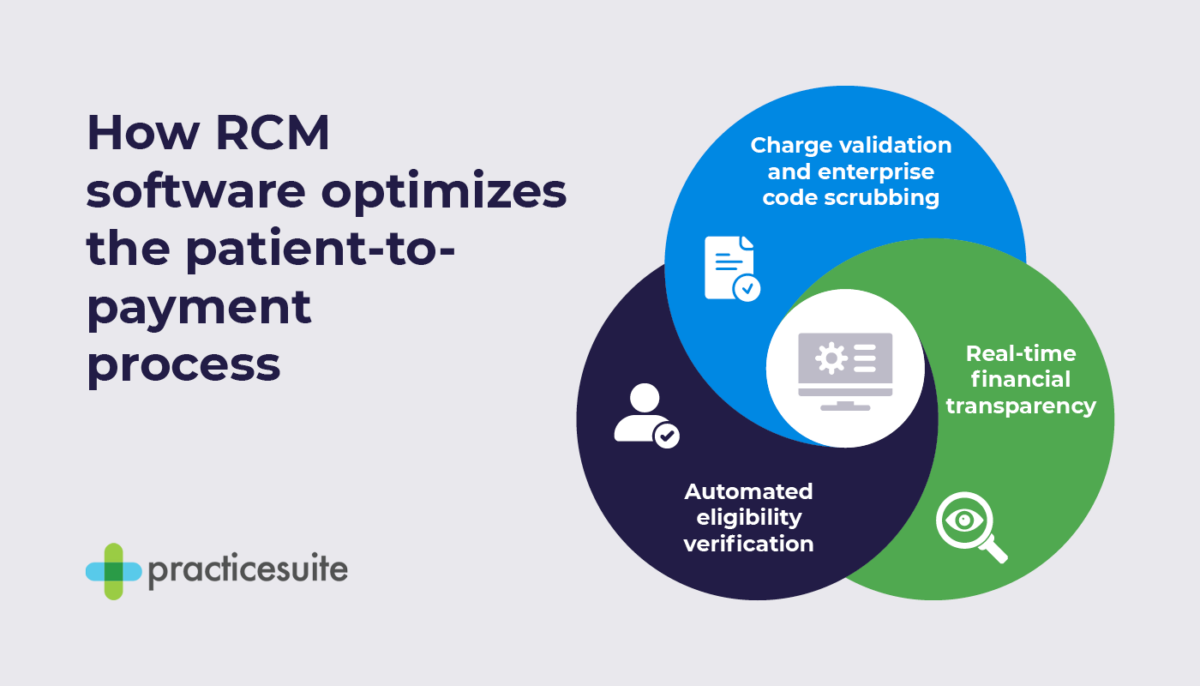
- Automated eligibility verification: Confirming insurance details before the patient visit prevents front-end denials and lets you know exactly what to charge for co-pays and fees, reducing manual rework for your billing team.
- Charge validation and enterprise code scrubbing: Advanced RCM systems can apply mass corrections and edits to your claims, validating charges and ensuring compliance with the latest payer requirements before the claim leaves your system to avoid preventable denials.
- Real-time financial transparency: RCM directors, medical group CFOs, and billing managers gain immediate visibility into accounts receivable (A/R) cycles, claim rejections, and denials via centralized KPI dashboards, enabling more accurate budgeting and strategic planning.
By verifying insurance coverage instantly and automating the scrubbing of claims against payer-specific rules, the software ensures your organization receives accurate payments in the shortest possible timeframe.
Best RCM Software Providers for 2026*
The following platforms represent the current top tier of revenue cycle technology. Selecting the right provider depends on your organization’s needs and goals, so read each section carefully to find a solution that serves you effectively in the long term.
Comparison of Top RCM Software Providers
| Provider | Core Software Features | Primary Target Audience | Key Advantage |
| PracticeSuite | Multi-client or multi-location single sign-on, mass claim corrections, and AI-driven fraud detection. | Medical billing companies and independent medical practices. | Only platform built specifically for B2B multi-client scalability and centralized A/R. |
| athenahealth | EHR, medical billing, practice management, and patient engagement. | Small and startup practices to large medical groups, enterprises, and health systems. | Interoperability via data exchange with other EHRs and the broader healthcare ecosystem. |
| Oracle Health | Massive, enterprise-level RCM solutions for every phase of the revenue cycle. | Enterprise health systems and hospitals. | Simple self-registration tools for patients and an intuitive, automated payment process. |
| CureMD | Customization, AI automation, and HIPAA compliance. | Specialty-specific clinics and small practices. | Sub-3-day denial resubmission times. |
| Greenway Health | Clinical, RCM, and patient engagement workflows. | Ambulatory and community health centers. | Holistic solutions based on each practice’s needs. |
| ModMed | Specialty-specific solutions for reducing manual tasks and improving documentation efficiency. | High-volume specialty groups. | Specialty-specific coding suggestions |
| OmniMD | AI-powered RCM solutions for end-to-end revenue optimization. | Specialty-specific practices. | Proactive denial prevention. |
1. PracticeSuite
PracticeSuite provides a centralized RCM platform designed for in-house directors to oversee every financial touchpoint. Its enterprise architecture allows for a consolidated view of your practice’s financial health, enabling directors to identify bottlenecks and optimize the patient-to-payment lifecycle without toggling between disconnected modules.
Key features of this solution include:
- Centralized oversight: Maintain total control over multi-location workflows and financial KPIs from a single, high-level administrative dashboard.
- Correction efficiency: Streamline A/R by carrying out mass claim corrections across different providers, significantly reducing manual labor for broad payer rejections.
- Specialty versatility: Native support for over 60 clinical specialties and 160 billing specialties enables in-house teams to handle complex billing rules and specialty-specific clinical requirements.
- Denial prevention and code scrubbing: The software identifies coding errors before submission, preventing easily avoidable denials.
- Advanced analytics and reporting: PracticeSuite’s Report Central tool includes over 140 financial reports to track financial stability, uncover revenue leaks, and reconcile end-of-day pay.
- Patient collections: This RCM software handles the patient side of A/R with robust tools, including eStatements, secure credit card storage, and a patient portal for convenient online payments.
- AI-powered functionality: We integrate AI across the complete patient-to-payment journey, including the front office, clinical office, and billing office. Our tools help you streamline documentation, enhance efficiency, and improve processing speed.
PracticeSuite also provides the only RCM platform tailored to the complexities of B2B medical billing companies and large medical groups. Our multi-location architecture empowers you to seamlessly manage the end-to-end revenue cycle for multiple clients.
2. athenahealth
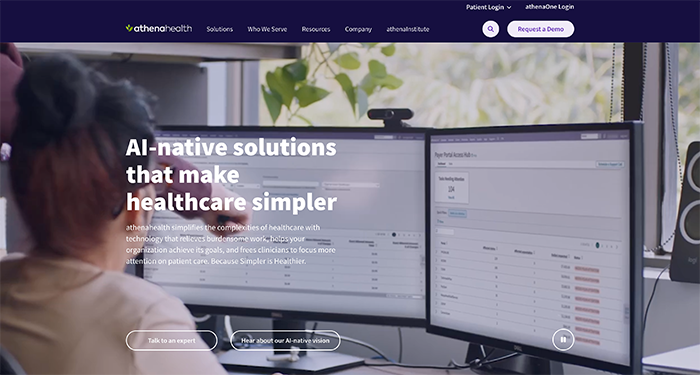
athenahealth is a fully integrated EHR, medical billing, and practice management solution, as well as a patient engagement tool. The platform leverages native AI tools to enable practices to view insights and trends across patient data and to deduplicate records, ensuring clean data.
Top features
- AI-driven waitlist scheduling that automatically refills canceled appointments.
- Automated insurance verification that immediately pulls and confirms patient insurance details.
- Data exchange with other EHRs and healthcare organizations to improve insights and make more informed decisions.
3. Oracle Health
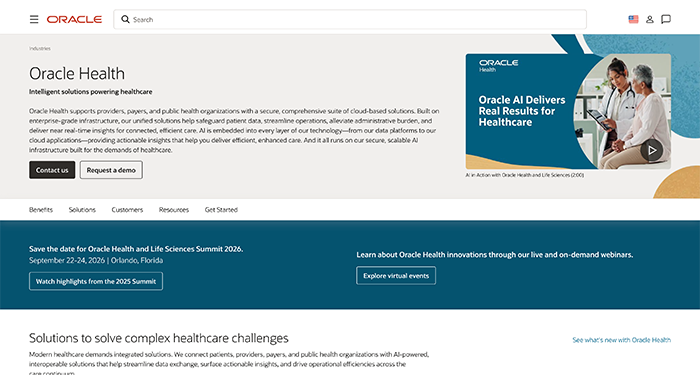
Oracle provides massive, enterprise-level RCM solutions that prioritize patient data security, streamlined operations, and real-time data insights. Their revenue cycle management software offers support at every stage of the revenue cycle.
Top features
- Intuitive, self-service registration options for patients so they can easily schedule appointments and check in, supporting staff productivity.
- Automated payment processing through Oracle Health Payment, a tool that reduces manual errors and limits unexpected service and processing fees.
- Built-in AI functionality to solve for administrative roadblocks without introducing new obstacles.
4. CureMD
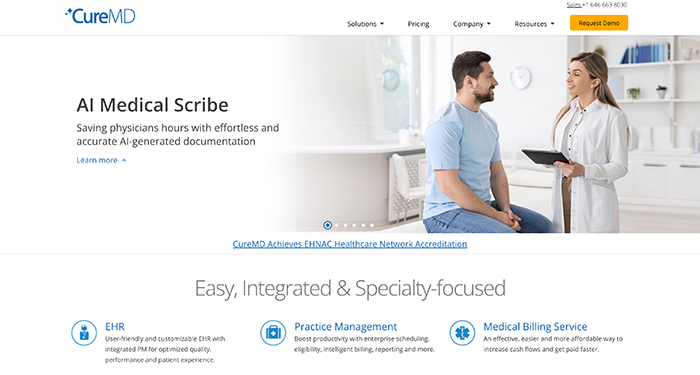
CureMD offers AI-powered RCM services designed to minimize claims lag and maximize cash flow.
Top features
- Patient financial experience optimization through price estimations, online payments, and self-service portals.
- HIPAA compliance to ensure patient confidentiality.
- Quick resubmission speed, with sub-3-day denial resubmission times.
5. Greenway Health
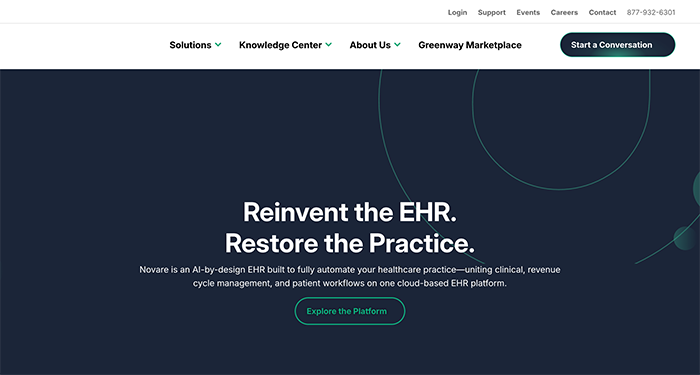
Greenway Health provides a unified platform that brings together clinical, RCM, and patient engagement workflows. Their complete set of RCM tools includes holistic solutions based on your practice’s unique needs.
Top features
- Revenue advisory to empower your practice with practical solutions backed by industry best practices.
- Optimized system configuration with efficient billing workflows.
- Robust analytics to help uncover revenue trends and opportunities.
6. ModMed

ModMed offers dedicated tools for specialty-specific solutions that prioritize physician speed by reducing manual tasks and improving documentation efficiency.
Top features
- ModMed Scribe 2.0 translates natural provider-patient dialogue into suggested visit notes and billing codes in real time.
- Specialty-specific coding suggestions and built-in claim scrubbing to limit denials.
- Dedicated onboarding and client support to ensure success.
7. OmniMD
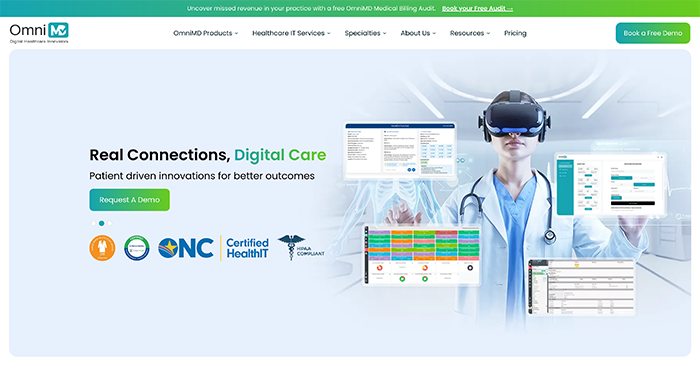
OmniMD targets practices that require highly customizable clinical workflows across more than 20 specialties. They offer AI-powered RCM tools that facilitate a self-optimizing revenue cycle and accelerate cash flows.
Top features
- Proactive denial prevention that uses historical data and payer-specific trends to identify potential rejections prior to submission.
- AI eligibility and benefits verification to minimize claim delays and patient surprises.
- Automated payment posting and reconciliation to access clean ledgers quickly.
RCM Software FAQs
What is the difference between RCM software and medical billing software?
Medical billing software is a tool designed to collect reimbursements from patients and various healthcare payers, including private insurance providers like Blue Cross and government-sponsored programs such as Medicaid. While it is a fundamental component of the broader revenue cycle, it remains distinct from a comprehensive management solution such as RCM software.
RCM software is a comprehensive financial platform that manages the entire lifecycle of a patient account, including pre-registration, clinical documentation, denial management, and advanced financial reporting. RCM software is distinguished by its elite or higher-level features that help an RCM director oversee their practice’s financial health and revenue cycle.
Additional key distinctions between these tools include:
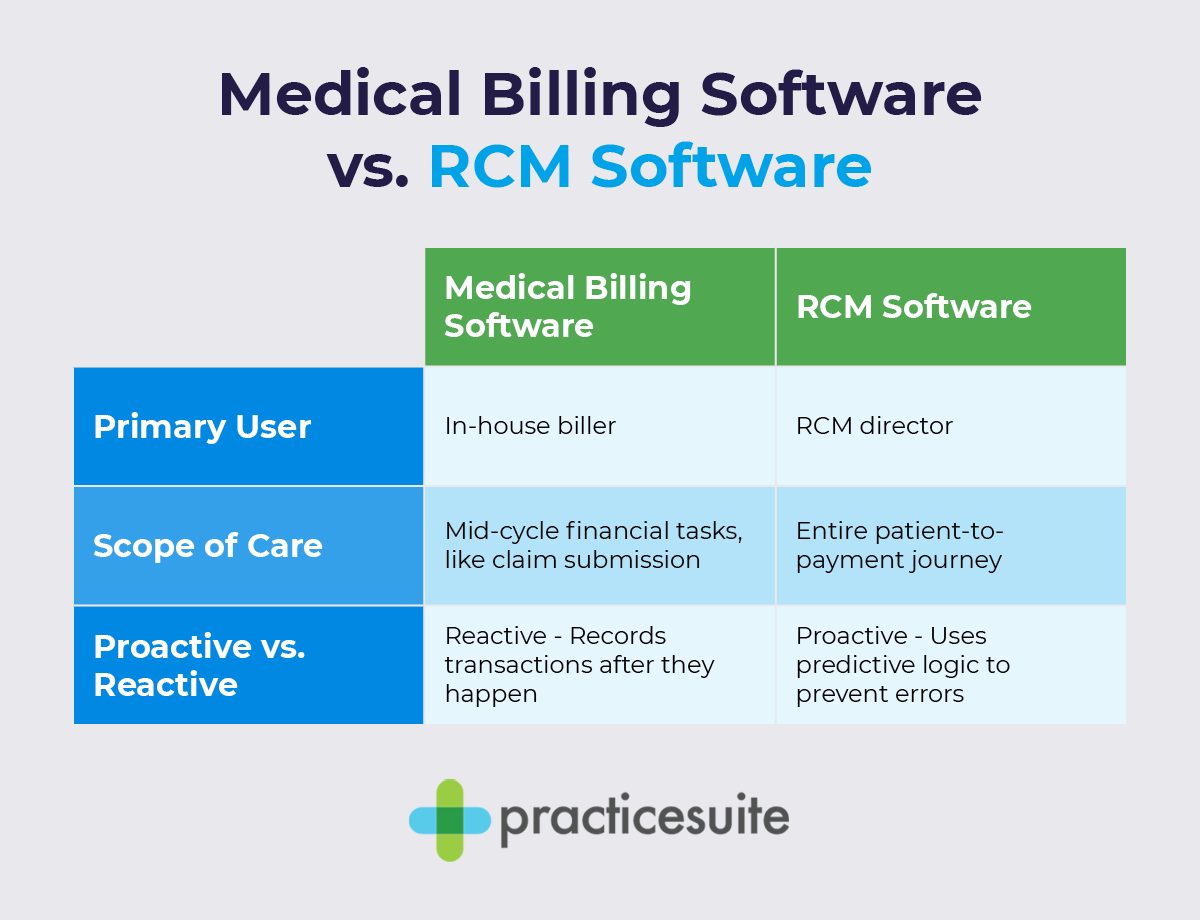
- Scope of care: Medical billing software focuses on financial tasks in the middle of the revenue cycle, such as claim submission. RCM software manages the entire patient-to-payment journey, including front-end eligibility and back-end analytics.
- Proactive vs. reactive: Billing tools record transactions after they happen. RCM software uses predictive logic to prevent errors from becoming denials.
- Strategic visibility: RCM platforms provide the multi-dimensional reporting needed by a CFO or RCM Director to forecast cash flow and identify systemic bottlenecks.
Does true RCM software include deep financial reporting and analytics?
Yes. Unlike basic billing tools, RCM software provides multi-dimensional analytics. This allows your organization to identify denial trends by payer, track provider productivity, and forecast future cash flow based on historical reimbursement patterns.
How can medical groups use RCM software to eliminate claim errors?
RCM software utilizes claim scrubbing technology that checks every submission against a database of payer rules. This identifies coding errors or missing data before the claim is sent, significantly reducing the likelihood of a denial or rejection.
Additional Resources
Managing a modern healthcare organization requires a financial system that can keep pace with evolving payer rules and rising patient volumes. By implementing a high-performance RCM platform, you move from a reactive billing approach to a proactive revenue strategy. You’ll stop chasing payments and start orchestrating growth.
Want to learn more about running a medical practice? Check out these resources:
- Medical Billing Software for Small Practices: Best for 2026. Medical billing software enables small and medium-sized practices to streamline billing and payments. Explore top solutions in this guide.
- 11 Top Medical Practice Management Software Tools for 2026. Robust practice management tools handle administrative, financial, and operational tasks to keep your practice running smoothly. Learn more in this resource covering top solutions.
- Top 7 Revenue Cycle Management (RCM) Companies of 2026. Discover additional RCM software providers to deepen your search and find the right tool for your unique revenue needs.
You focus on patients. We’ll get you paid.
Leverage robust RCM software from PracticeSuite for end-to-end revenue optimization.

*The information published on this page is based on independent market research conducted on May 22, 2026. The content presented is intended to be objective, accurate, and reflective of the information available at the time of publication. PracticeSuite makes no representations or warranties regarding the accuracy or completeness of the information presented, which is provided for informational purposes only.
If you identify any inaccuracies, updates, or changes to the information provided, please contact us so we can review and update the content as appropriate.