Authorization Denial in Medical Billing & How to Prevent It

Although medical claims are a primary way medical practices receive payment, medical offices often lack the time and expertise to handle authorization denials. In 2024, Medicare Advantage insurers denied 7.7% of prior authorization requests, and only 11.5% of those denied requests were appealed.
However, of the denials that were appealed, over 80% were fully or partially overturned. These statistics tell us that appealing works, but most practices simply don’t have the time or staff to handle that process.
This guide will help your practice handle authorization denials in medical billing. In it, we’ll cover:
- FAQs About Authorization Denial in Medical Billing
- The Top Reasons Claims Are Denied and Their Denial Codes
- How Denied Claims Hurt Your Medical Practice
- Best Practices for Reducing Authorization Denial in Medical Billing
- PracticeSuite for Authorization Denial in Medical Billing
Don’t write off claims denied for lack of authorization as a lost cause. With the right strategy and process, you can appeal and overturn denials to ensure your practice gets paid for its patient care.
Reduce authorization denials with PracticeSuite.
Our revenue cycle management and medical billing make creating, submitting, and appealing claims easy.

FAQs About Authorization Denial in Medical Billing
What is prior authorization?
Prior authorization is a requirement from a health insurance company that requires a provider to obtain approval before rendering a specific healthcare service, executing a treatment plan, or prescribing a particular drug. Usually, prior authorization is required to help healthcare payers verify that the proposed treatment is medically necessary, safe, and cost-effective before they agree to cover the cost. If a required prior authorization is not obtained, the payer will likely refuse to pay for the service.
What is an authorization denial?
An authorization denial occurs when a health insurance company reviews a prior authorization request and officially refuses to approve or pay for the proposed treatment. These occur for a variety of reasons, ranging from clerical errors to clinical disputes in which the payer believes the treatment is not medically necessary or that a cheaper alternative should be tried first. We’ve included a list of the most common authorization denials in medical billing below.
What is the difference between a rejection and a denial?
Simply put, claim rejections happen before the claim is fully processed, and claim denials happen after the payer processes the claim. Claim rejections are usually caused by a clerical error or missing data that prevents the claim from entering the payer’s system. Rejected claims can typically be fixed quickly and resubmitted.
Claim denials, on the other hand, occur when the payer processes the claim and determines it is unpayable under their coverage rules. Denials require a more formal appeal process to overturn, making them more complicated to resolve.
What is medical necessity?
Medical necessity is the standard used by Medicare and commercial payers to determine if a healthcare service should be covered. According to the American Medical Association, a healthcare service or product is medically necessary if it is:
- Needed to prevent, diagnose, or treat an illness, injury, disease, or its symptoms
- In accordance with generally accepted standards of medical practice
- Clinically appropriate in terms of type, frequency, extent, site, and duration
- Not primarily for the economic benefit of the health plans and purchasers or for the convenience of the patient, treating physician, or other health care provider
The Top Reasons Claims Are Denied and Their Denial Codes
Understanding exactly why a claim was rejected is the first step in recovering your revenue, which involves familiarizing yourself with the most common authorization denial codes you’ll come across and the scenarios that trigger them.
Common Authorization Denial Codes
When your claim is denied, you’ll receive an Electronic Remittance Advice (ERA) document that includes an alphanumeric code. This code tells your billing team exactly what went wrong and who is financially liable for the denied amount. The most common codes fall into two major categories: CO Authorization Denial Codes and PR Authorization Denial Codes.
CO Authorization Denial Codes
“CO” stands for Contractual Obligation. As a medical practice, if you receive these codes, then the financial liability for the treatment falls on you. You must either write off the charge or successfully appeal it, and you aren’t allowed to bill the patient for the balance.
The most common CO codes include:
- CO-15 (Authorization Number Missing or Invalid): The authorization number was either typed incorrectly or pulled from the wrong portal, or the date range attached to the ID has expired.
- CO-197 (Precertification/Authorization Absent): The payer has no authorization on file. This code usually means that the front desk failed to request authorization or that the request was submitted but never finalized by the payer.
- CO-27 (Expenses Incurred After Coverage Terminated): This situation happens when a patient’s insurance policy expires or changes between the date the prior authorization was approved and the actual date of service.
- CO-198 (Precertification/Authorization Exceeded): For this code to apply, the provider has to have performed more units of a service or a more complex procedure than what was originally approved in the initial authorization.
- CO-16 (Claim Lacks Information): Often paired with other remark codes, this means critical data required to validate the authorization—such as the patient’s weight, the NDC code for a drug, or the supervising provider’s NPI—was left blank.
PR Authorization Denial Codes
“PR” stands for Patient Responsibility. If you receive one of these codes, then it means that the patient is responsible for the balance.
The most common PR denial codes include:
- PR-197 (Precertification/Authorization Absent): This is the same error as CO-197, but with a different financial outcome. Under certain health plans, the burden of securing the prior authorization or referral falls on the patient, not the provider. If the member fails to obtain this approval before attending the service, the practice can legally bill the patient for the full amount.
- PR-242 (Services Not Provided by Network/Primary Care Providers): This code is triggered when a patient sees an out-of-network provider or a specialist without the required pre-authorization from their primary care physician. Because the patient bypassed the proper authorization channels, they are responsible for the bill.
- PR-40 (Charges Do Not Meet Qualifications For Emergent/Urgent Care): True emergency services are generally exempt from prior authorization. However, if the insurance company audits the claim and decides the patient’s condition wasn’t a “true” emergency, they will deny it with this code. The payer is essentially stating that because it wasn’t an emergency, standard prior authorization rules applied, and since none was obtained, the patient must pay.
Common Scenarios That Trigger These Denials
Beyond the codes themselves, authorization denials usually boil down to a few core operational breakdowns, including:
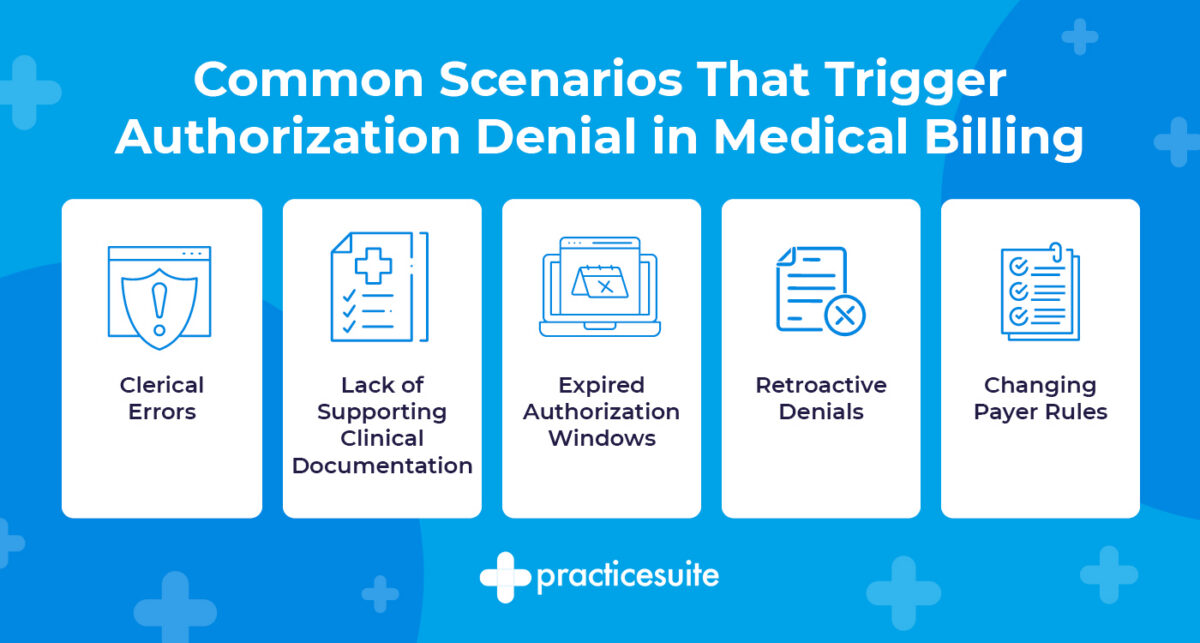
- Clerical errors: The number one cause of denials is human error. Misspelling a patient’s name, submitting the wrong CPT code, or mismatching diagnosis codes will instantly trigger a rejection.
- Lack of supporting clinical documentation: Payers frequently deny authorizations when the submitted medical records do not clearly prove medical necessity. If you fail to include treatments the patient has already tried or specific patient comorbidities, the payer will assume the procedure is elective.
- Expired authorization windows: Authorizations are not indefinite. If an approval is valid for 30 days and the patient reschedules their procedure to day 35, the claim will be denied unless staff members secure a formal extension.
- Retroactive denials: These situations occur when the insurance company retroactively retracts the approval and denies the claim on the back end. This kind of denial typically happens either because the payer conducted a post-payment audit or the patient lost coverage just days before the procedure.
- Changing payer rules: This circumstance will most often result in a “soft” denial, which can be remedied by resubmitting the forms in accordance with the payer’s updated specifications.
As frustrating as the prior review process can be, providers should not give up hope. Most of these issues occur when billers and claim managers are unable to keep up with their workloads or don’t have the capacity to handle prior authorizations. In that case, investing in medical billing software or revenue cycle management (RCM) services can help them minimize authorization denials and improve their medical billing.
How Denied Claims Hurt Your Medical Practice
A single authorization denial might not seem significant to your medical practice, but if multiple denials pile up over time, they can pose a threat to your medical practice’s financial stability and operational efficiency. Specifically, a high volume of denied claims negatively impacts your clinic in three critical ways:
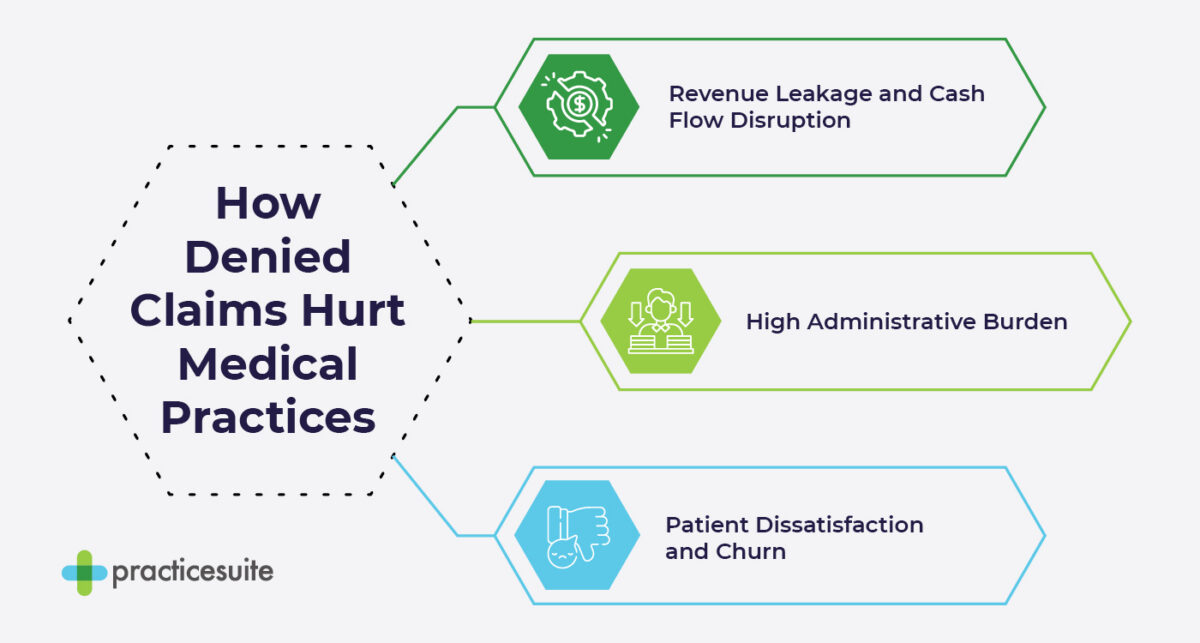
- Revenue leakage and cash flow disruption: Denials trap revenue, increasing your Accounts Receivable (A/R) days and turning delayed payments into permanent write-offs if strict appeal deadlines are missed.
- High administrative burden: Reworking a denied claim is expensive and time-consuming, forcing your billing team into a cycle of phone calls and paperwork, which can lead to staff burnout.
- Patient dissatisfaction and churn: Denials directly halt necessary medical treatments. In fact, according to a recent AMA survey, 29% of physicians report that the prior authorization process has led to a serious adverse clinical event for a patient in their care. Coupled with the surprise out-of-pocket bills that often follow a denial, denied claims can harm patients’ trust (not to mention their health) and drive them to seek care elsewhere.
To protect your practice’s independence and profitability, you need to shift from a reactive appeals mindset to a proactive denial prevention strategy that catches these errors before a claim ever reaches the clearinghouse.
Best Practices for Reducing Authorization Denial in Medical Billing
To drastically reduce your authorization denial rate before claims ever leave your office, your practice should implement these four essential strategies:
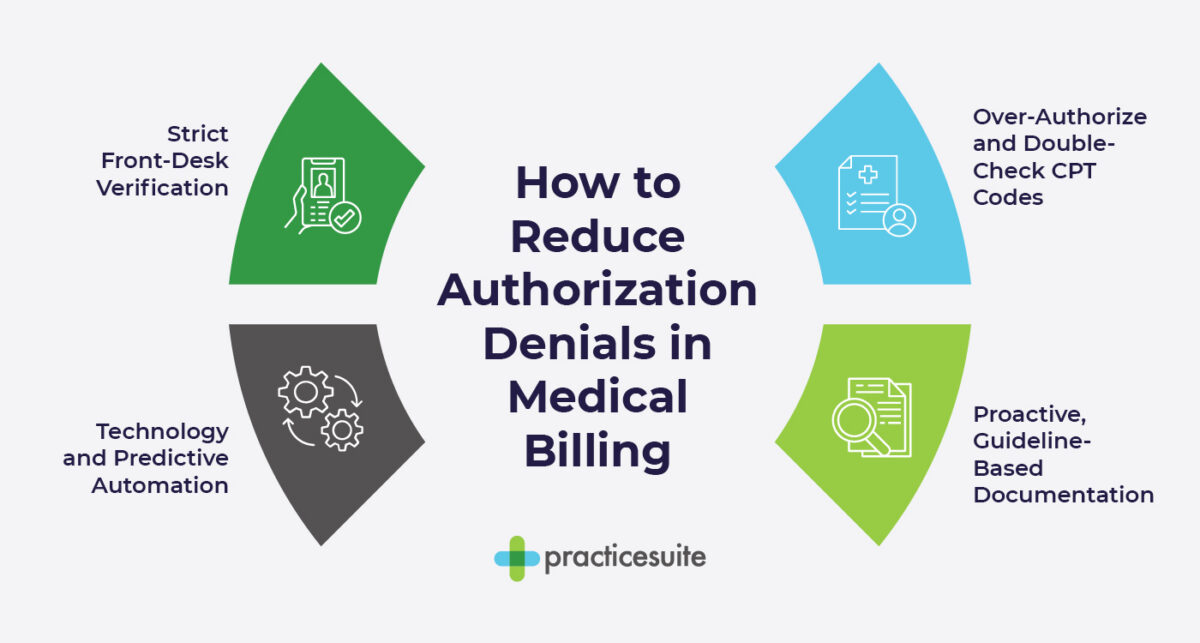
- Strict front-desk verification: Make it part of your standard eligibility process to check whether prior notification is required for every visit, order, procedure, and referral. Don’t wait until the day of an appointment! Staff should run these verifications 48 hours prior to each visit to confirm active coverage and specific CPT rules.
- Over-authorization and double-checking of CPT codes: Billers and physicians must work together to mitigate denials caused by unexpected procedural changes. There is no penalty for authorizing a procedure and not completing it, so it’s always better to err on the side of requesting authorization for all possible scenarios while verifying that you’re using the correct CPT codes.
- Proactive, guideline-based documentation: Base your initial pre-authorization requests on respected, evidence-based clinical guidelines (like AHRQ or specific payer policies). If you deviate from standard guidelines, document the “why” clearly so the payer can understand your reasoning.
- Technology and predictive automation: Modern medical billing and RCM software utilizes AI and predictive scrubbing to scan your claims against millions of historic payer algorithms, flagging missing authorizations or conflicting codes before the claim is sent to the clearinghouse. Investing in these solutions saves your team time and work.
Some denials will occur regardless of how diligent your staff members are. However, by following these best practices, you can ensure your staff can focus on maximizing incoming cash flow and getting patients the timely care they deserve.
PracticeSuite for Authorization Denial in Medical Billing
Navigating prior authorizations manually is a significant drain on your practice’s time and resources.
PracticeSuite’s comprehensive medical office platform and specialized RCM services are designed to take this burden off your shoulders entirely. By integrating advanced technology with expert billing support, PracticeSuite helps you catch errors early through features such as:
- Automatic prior authorizations: PracticeSuite’s solution includes real-time insurance verification and prior authorization capabilities, so you can be sure patients are covered before performing any services.
- Predictive claim scrubbing: Our intelligent medical billing software automatically checks your claims for missing authorization numbers, mismatched CPT codes, and expired approval windows before they reach the clearinghouse.
- Expert RCM services: If your practice is ready to outsource its billing work, PracticeSuite’s specialized RCM services can handle the heavy lifting for you. From securing initial authorizations to executing complex appeals, our knowledgeable team can handle all of your billing workflows.
You don’t have to accept a high denial rate as just the “cost of doing business.” By partnering with PracticeSuite, you can reclaim your staff’s time, protect your patient experience, and ensure you get paid for every service you provide.
Reclaim your time and revenue with PracticeSuite.
Minimize authorization denials with our medical billing software and dedicated RCM services.
Additional Resources
Your medical practice can no longer afford to sit back and wait to react to denial codes. Instead, a proactive approach ensures you’re paid for the patient care you provide while minimizing headaches from appealing rejected or denied claims. With the best practices in this guide, you can optimize your workflows and reduce authorization denials in your medical billing.
For more resources like this one, check out the articles below:
- 20+ Best Medical Billing Software Solutions. Medical billing software streamlines your billing work, making it easier for your practice to get paid. Explore the top solutions here.
- Top 7 Revenue Cycle Management (RCM) Companies. Medical billing is just one component of RCM. Discover top RCM companies and how they can help your medical practice.
- The Top 10 AI Medical Billing Software Solutions. AI has taken the world by storm, and the medical industry is not immune. Learn more about how AI works in medical billing software.